Featured
Showing posts with label harbiye. Show all posts

Friday, 1 May 2015

Istanbul Military Museum: Big, Detailed Museum with a Lovely Yard


Istanbul Military Museum is a big museum at Harbiye. It has a lovely yard with cats and flowers. We even saw two green wild parrot on a tree. We hadn't been inside the museum before. We decided just to take a look at it and after 3-4 hours we had walked our feed off. So, we advise you to take your time and to leave your baggage somewhere if you can.

The museum covers an area of 54.000 m2 and the museum building is 18.600 m2. It was build in 1862 for the purpose of education officers for the army. Abdulhamit II had it built. Mustafa Kemal Ataturk was a student of this school for some time, you can visit his figurative class inside. The building was used as a school until 1936, and as corps headquarters until 1964.

In 1964, the decision was made to turn it into a museum. Its restoration was started in 1966 and was finished in 1991. Many spatial and functional changes were made. These changes made the building somehow different both inside and outside than the older building that was used as a military school. I don't know what it looked like before, but it looks fine now.

The building was originally Aya Irini Church, and  when Fatih conquered "Constantinople", he turned it into armoury. The remains, some of which were ancient, were protected. So it can be said that first museum activities started then. The artifacts were carried to Nigde on the account of World War II. Then it was brought back to Macka Armoury, which now belongs to Istanbul Technical University. Today they are in Cinili Kosk, inside Istanbul Archaelogical Museum complex.

Inside the Museum


First of all (and normally) it is a very patriotic museum. The first floor begins with ancient Turkish history: Huns (who I equate with Vikings in terms of the active pnosition of women in migrant settler society), Gokturks (with an interesting alphabet) and Uyghurs (whose grand-grandchildren are still living in China). You can observe the migratory roots. There is a statue of Attila the Hun.

Then comes the Seljuks. I like their art. They are in between Turkish Shamanism and Islam. Normally, Islam forbids paintings and statues. But the Seljuks were in a transition period. Their art includes lion statues, story depictions etc. There are many traces of Seljuks around Turkey. You can watch the slide on the screen and see their pictures. Unfortunately you won't see Istanbul among those, because they couldn't make it to Istanbul at that time.


There are many things about the Ottomans, and there should be considering the period of time they reigned (1299-1922). You'll see things about the conquest of Istanbul. The steps and the wars that lead to Turkish republic are also exhibited in various rooms. You can visit the figurative class of Ataturk. You can see him discuss with his friends during The War of Independence.

The museum is also rich of statues and artifacts, such as men on horses, study tables, an old car (that witnessed and assassination of one of its passengers), and on the second floor guns and arms of every kind. For your information: Everyday at 15.00-16.00, you can watch the jannissary band perform.

Outside the Museum


The yard of the Istanbul Military Museum is very pleasant. There are trees and flowers. There are artifacts such as a real military helicopter and a real big cannon. Cats wander around and most of them are very friendly. One of them was so friendly that it accomponied us until we went into the museum building.

The museum today is a building complex with some newer additional buildings, but the yellow building you'll see is only newer than the museum building. It has actually Ottoman tughra and inscriptions on it. After you exit the complex, walk towards Nisantasi and visit Sanatcilar Park, which is a minute walk away. There you'll find the most comfortable cats, kittens and dogs of Istanbul.


Monday, 2 March 2015

Harbiye: From Military School to Events' Center

Harbiye is a neigbourhood at Sisli district. Harbiye means "the school of war/military school" and actually took its name from a "harbiye". It is neighbours with Nisantasi, Pangalti and Elmadag. Being close to popular attractions and the historical arcitecture makes Harbiye charming for both residents and tourist.

Like many neighbourhoods of this area, Harbiye was inhabited by Levantines, mostly by the ones who ended up homeless after Beyoglu fire in 1870. They moved in the beautiful stone buildings, some of which can still be seen today.

A lovely house among many more.
There are some good attractions to visit at Harbiye:

Istanbul Military Museum was built as Military School in 1834 by Mahmud II and the building used as museum was built in 1864 by Abdulhamit II. Today you can visit the museum and see the Ottoman architecture. Jewelry expoes are organized a couple of times a year, there you can find diamonds at good rates.

Istanbul Broadcasting House/Istanbul Radio building was opened in 1949. The radio began broadcasting in 1925, but it needed a better equipped building. Today it is still a broadcasting house, just situated on the main street, namely Cumhuriyet Street.

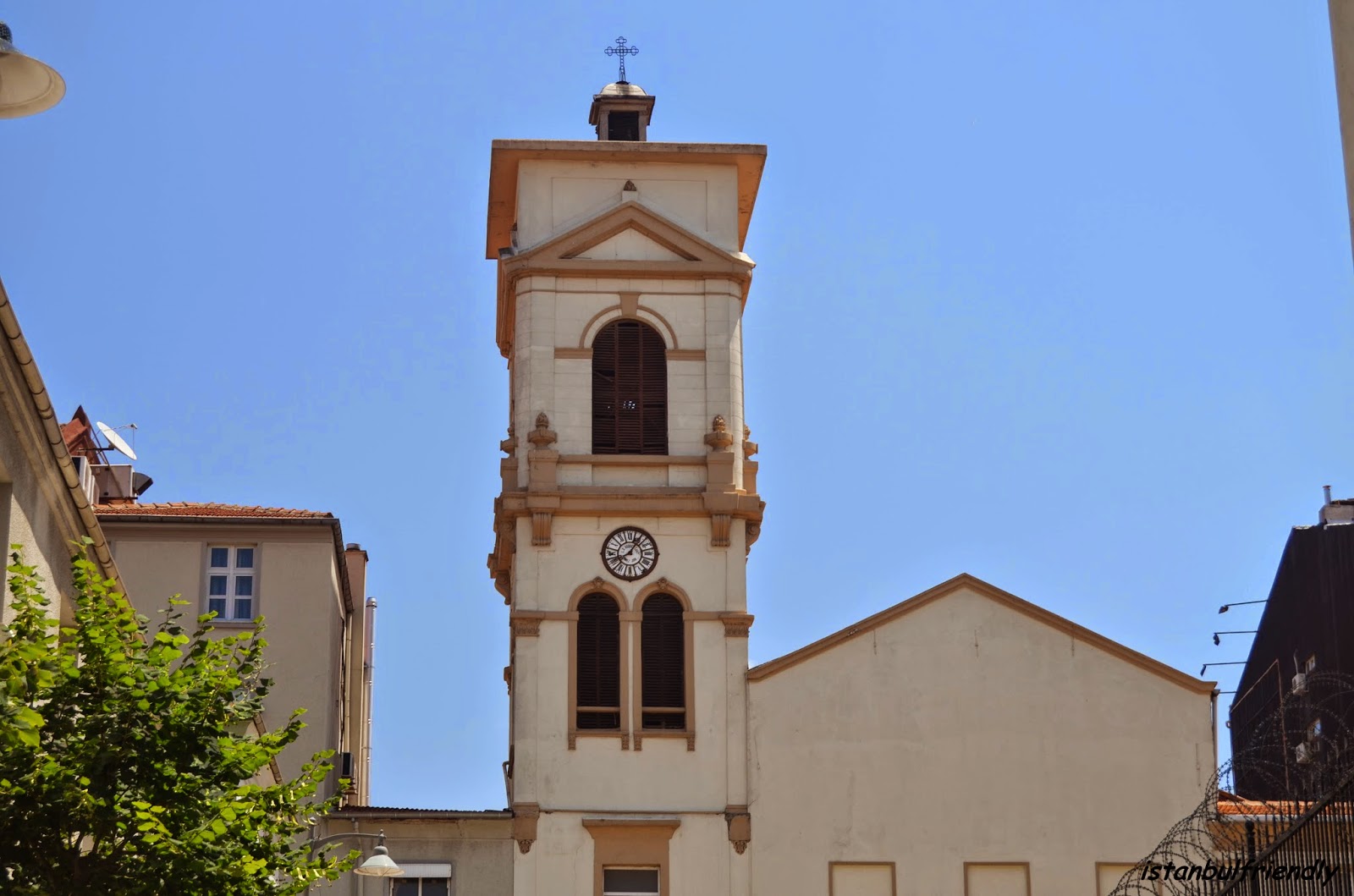
Another important building at Harbiye is the Vatican Embassy. It is situated in Papa Roncalli Street and opposite of the belfry of St. Esprit Cathedral. Papa stayed at the complex that belong to the embassy.

Notre Dame de Sion is one of the French high schools in Istanbul. It is a private school that was founded in 1856. It started as a school for girls at Ottoman times, but today it is a mixed-sex school. The building is simple and nice. Don't miss it, if you are walking around. It is also on Cumhuriyet Street.

You can enter St. Esprit Cathedral from one of the gates of Notre Dame de Sion. It is a little bit hidden and very well preserved. It has a small yard, but the interior is bigger. On Sunday services, it is totally full.
The belfry of St. Esprit Cathedral
Harbiye is also famous for its events:

Muhsin Ertugrul Theatre one of the biggest theatres in Istanbul, where you can watch the plays of Istanbul Municipality Theatre. Unfortunately, the plays are in Turkish.

Cemil Topuzlu Open Air Theatre houses some open air plays and concerts at summertime. Games are again in Turkish, but you can listen to the concerts of local and global musicians.

Lutfi Kirdar Convention and Exhibition Center was Istanbul Sports and Exhibition Center in 1948-1988, then it was named after Lutfi Kirdar, who was a doctor, statesman, soldier, governor of Manisa and Istanbul, deputy and minister of health. The building went into some restorations and took its recent shape.

How to get to Harbiye?


Harbiye is ten minute walk away from Taksim and Nisantasi, so it is a convenient option. You can use the metro, but then you should either walk from Pangalti or Taksim station (for no more than ten minutes). You can also get on a bus that works between Mecidiyekoy-Taksim line. TRT Istanbul Radio stop is exactly in front of Notre Dame de Sion. There are also shared taxies from Harbiye to Besiktas.

Where to stay in Harbiye?


There are many hotels and suits to stay in Harbiye. The ones on the main street will be more expensive. Try the smaller streets. Harbiye is generally a nice neighbourhood and the number of suits are increasing day by day.

If you have the budget, you can stay at Hilton Istanbul Bosphorus Hotel. I have never stayed at the hotel, so I can't tell anything about its services. The reason for me to put a footnote for this hotel is that it is the first five star hotel of Istanbul. It was opened in 1955. Another interesting thing is that Conrad Hilton  was the second husband of Zsa Zsa Gabor, who convinced Conrad to open a Hilton hotel in Istanbul. Zsa Zsa Gabor was a Hungarian actress and socialite, whose first husband was Burhan Asaf Belge. (Burhan Asaf Belge was a Turkish intellectual, his son Murat Belge is also a famous intelectual who has a detailed Istanbul guide, and his deceased nephew Yakup Kadri Karaosmanoglu is a famous novelist. What a family!)

So much for the gossip and Harbiye!

Wednesday, 4 February 2015

Pangalti: District with a Levantine History

Pangalti, or Pancaldi is a district between Osmanbey and Harbiye. The older name, Pancaldi, is Italian. (There is still a Pancaldi Restaurant within Ramada Plaza Istanbul City Center.)

In the past, Levantine (Latin Christian) population was dense, but today the percentage has fallen dramatically (mostly due to events in 1955). There is still a Pangalti Armenian Catholic Church at Pangalti. Be quick to see it from the main street. The properties that once belonged to Armenians seized in some way and many buildings are demolished (probably in order to build just another big mall!). 

Pangalti Armenian Catholic Church
Pangalti witnessed a historical turning point. The first Labour Day was celebrated here on May 1st, 1912. The gathering place of the workers was the Belvu Garden, which doesn't exist today. (It is hard to find something green between Sisli and Taksim, except graveyards.)

Agos Newspaper is at Pangalti. Its address says Osmanbey, but the confines are vague between them. Agos means "planting seed" in Armenian. On January 19, 2007, the Armenian journalist Hrant Dink was shot dead in front of the newspaper building. One of the paving stones is a memorial stone, keep your eyes down and open, while you're walking.

Pangalti is quite a cosy street. There are markets and beautiful old houses everywhere.

Pangalti hotels


Pangalti is a very central district and houses some big hotels, including Ramada Hotel. There are also residences and suites. Everything here is central, so look for the price and comfort.

Pangalti transportation


The Dolapdere exit of Osmanbey metro stop is just in the middle of the street, and next to the exit, there is a bus stop. You can walk to Osmanbey, Kurtulus, Harbiye, Nisantasi and even Taksim.

Monday, 2 February 2015

Nisantasi: Let's Get a Little Bit Fancy

Nisantasi is named after the marking stone (nisantasi) on the intersection of Tesvikiye Street and Rumeli Street. It contains the close parts of Mesrutiyet and Tesvikiye neighbourhoods around Vali Konagi. The neigbours of Nisantasi are Macka, Harbiye, Osmanbey and Tesvikiye. Nisantasi is famous for globally known brands and cafés. I also like the old and beautiful houses and the comfortable atmosphere.

Valikonagi Street is the biggest street of Nisantasi. "Vali konagi" means "the governor's mansion" in Turkish. The mention of the Istanbul governor is literally there. The governor changes, but the use of the mansion doesn't change. You will notice the building on the opposite of Mim Kemal Oke Street. On the same street, there is also the house that famous architect, Vedat Tek himself designed.


Nisantasi usually hosts the best New Year's celebrations in Istanbul. The second biggest street, Abdi İpekçi Caddesi is decorated with trees and lights. The New Year celebrations were cancelled due to budgetary savings.

Visit the Demokrasi Park, whenever you can. It is literally full of cats! Most of my cat photos are taken there. There are benches and a little tea house to pass lovely time. And again, cats. (I even saw a rooster there.) The most luxurious cat houses are there. That's Nisantasi!


History


To repeat again, Nisantasi is named after the marking stone. Actually there are three stone signs, the third one is on the yard of a building at Ihlamur Yolu (I'll try to find it for you). The third and the second one are from the reign of Mahmut II in 1811. The first stone, our stone in question, is from the reign of Selim III in 1790-1791.

It is hard to separate Tesvikiye and Nisantasi. Before a different blog post about Tesvikiye (meaning incentive, encouragement), some summary is needed here. Selim III ordered the neo-classical police station and the neo-baroque Tesvikiye Mosque. Selim III ordered two stones which marked the beginning and the ending of the quarter. (Third one? I don't know.)

After the Balkan Wars in 1912-1913, Turks from Macedonia and Thessaloniki moved to Nisantasi. The family of Nâzim Hikmet was also among them. (Nâzim Hikmet was born in Thessaloniki.) There were also Greek, Jewish, Armenian and Levantine citizens. I don't know have many of them are left after the events at September 6-7, 1955, which affected mostly Taksim, Pangalti, Harbiye and Nisantasi.


Where is Nisantasi


Nisantasi is in Sisli district and it is quite close to Taksim and Mecidiyekoy. The transportation options are vast. I love the streets around Halaskargazi and Cumhuriyet streets. Walking from Taksim or Mecidiyekoy will take at most 20-30 minutes.

The traffic jam isn't so bad, compared to the rest of Istanbul, unless you run into work hours. The working hours usually affect the direction to Mecidiyekoy at evenings (That's my deduction as a person who works at Mecidiyekoy).

So, if you like to get on the bus, it is also a viable option (Osmanbey and Pangalti stops are both okay.) Read the bus signs. There are many buses that use Halaskargazi and Cumhuriyet streets (Mecidiyekoy-Sisli-Osmanbey-Pangalti-Harbiye-Elmadag-Taksim line is one of the most lively lines in Istanbul.)

You can also try the metro, but if you are coming from Taksim or Mecidiyekoy, it is not worthwhile to travel underground. The undergrounds in Istanbul are so underground that it is more practical to walk when the destination is Nisantasi. The name of the metro stop is Osmanbey. There are different exits which are all walkable, even if you choose the wrong one.

From Nisantasi, you can walk to Fulya and Besiktas.


Tips


* Nisantasi is one of the richest and kindest districts in Istanbul. I think, it is also one of the safest. The interesting thing is that even thinner addicts say please, if they are in Nisantasi or somewhere close.

* Nisantasi has shops, restaurants and cafés for every budget. However, still check the prices, in case you enter somewhere expensive. The attitudes are better than Taksim and Sultanahmet, so the need for bargaining may be less.

* Walking in Istanbul requires to look ahead, but don't miss the beautiful building. Take numbers of photos. Nisantasi is one of the few places in Istanbul, where a single woman taking photos draws almost no attention. (If someone here or at any part of Istanbul says "photo, photo" looking at your face smiling, just ignore that creature.)

* Nisantasi University has almost nothing to do with Nisantasi. There is just a small building at Kurtulus and the rest is somewhere irrelevant.

Tuesday, 27 January 2015

Elmadag: A Cosy Neigbourhood Near Taksim

Elmadag means "apple mountain" in Turkish. The confines aren't precise, but it is rougly between Harbiye, Taksim and Dolapdere.

Elmadag is very close to Taksim, so it is always popular among tourists, especially among Erasmus students and backpackers. There are many studio apartments, suites and rooms.

Elmadag Street is the next parallel to the Babil Street. There are many beautiful houses in between. Like Nisantasi, Harbiye and Taksim, the buildings are looks more Western. Surp Agop Apartment is one of the best examples you'll see around.

Surp Agop Hastanesi is an Armenian public hospital. I haven't been there yet, but people speak highly of it. So, if you need a hospital (I hope this won't happen), you can try it. However, it is a private hospital. The only public hospital is Sisli Etfal (because Taksim Acil is demolished in order to open space for a mall, and was carried to Gaziosmanpaşa, which has nothing to do with Taksim).


Where is Elmadag?


Elmada is between Harbiye and Taksim. There is directly a bus stop named Elmadag. I think you don't need to get on anything, when you are coming from Taksim. It is just a ten minute walk.

If you're coming from the other directing follow the bus stops: Harbiye, TRT Istanbul Radyosu and there you are, Elmadag.

There is no direct metro station. So, you'll have to walk either from Taksim or from Pangalti/Osmanbey.

Sunday, 25 January 2015

St. Esprit Cathedral: Papa Was There

St. Esprit Cathedral resides in Harbiye, on Cumhuriyet Street and next to Babil Street. It had very busy times a couple of months ago, because it hosted Pope Francis.

Today it is surrounded by Notre Dame de Sion High School. The entrance is from Cumhuriyet Street side. It has a lovely yard and a Papa XV. Benedictus statue on it. If you walk the rear street, the Papa Roncalli Street, you can see the bell tower. (The Vatican Consulate is also on the Papa Roncalli Street.)


The construction started in 1845 and the cathedral was open to worship in 1846. The architect is Gaspard Fossati. The cathedral was damaged by an earthquake in 1865. There is an underground grave, which was active until 1927. The grave of Giuseppe Donizetti, who founded Mizika-i Humayun (a military band), is there.


How to go to St. Esprit Cathedral?


It is very easy to visit St. Esprit. It resides in a beautiful district with convenient transportation. There is the bus stop, TRT Istanbul Radyosu, just in front of the high school. If you come from Taksim, you'll have to cross the road. If you come from Mecidiyekoy, you'll be there. You can also walk to and from Taksim, Nisantası, Tesvikiye, Macka and even Besiktas.

If possible, don't miss the Sunday service!


Thursday, 11 December 2014

Talimhane Hotels: The Address to Superfine Holidays

Talimhane is actually a neighbourhood of Beyoglu. It is very close to Taksim Square and Gezi Park. Talimhane was once an exercise place for the army. Today it serves an entirely different purpose. It hosts many superfine hotels. You can also find fine restaurants around.

The list of hotels at the entrance near Gezi Park.

There are many hotels at Talimhane. Not all of them may be suitable for backpackers and students, but you can check them out for they are so central. There are boutique hotels, 4 star hotels, 5 star hotels and luxurious hotels. When you walk straight from this entrance to the end of the road, you'll reach Tarlabasi. Some Tarlabasi hotels are also counted as Talimhane hotels, because Talimhane doesn't have strict borders and it is okay that way.

Only pedestrians!

Talimhane is closed to traffic. So it is fun to walk around. You can go there by any means that takes you to Taksim Square. It is only one or two minutes walk from the square. By the way, you see the "P" of the Point Hotel at the right of the picture. And the right of it, there are Havatas buses that takes you to either Ataturk International Airport or Sabiha Gokcen Airport (with a fair price).

Monday, 1 December 2014

Gezi Park: The Rebellious Park of Istanbul

Gezi Park would probably be just another park in a city, if it hadn't hosted the greatest "social" demonstration in the history of Turkey. "It all started with a tree", you would hear. But when the police used disproportionate force against peaceful protesters who wanted to protect Gezi Park from becoming barracks, things went crazy. For a couple of months, flying gas canisters were a usual scene from Taksim to Galata and to Harbiye, and also at Kadikoy. It is worth to remind that despite fierce political sayings, the park is still there, safe and sound, and I'm glad to tell you about it.


The History of Gezi Park


When you see Gezi Park, you may find it small in comparision with other parks at other big cities in the world. But the park's newly assigned historical significance makes it larger than life. However, it doesn't mean the only historical memory of the park.

Let's start with earlier records. The area including Gezi Park, Divan Hotel (the hotel next to the park that let the protestors in when the violence was at its peak), Hyatt Regency Hotel, and some parts of Istanbul Radyoevi (broadcasting house) and Harbiye Orduevi (military museum and cultural center of command) was Pancaldi Armenian Graveyard, or Surp Agop Graveyard. (Surp Agop Apartment still exists, but the hospital was demolished last year and the apartment serves as a polyclinic. The graveyard being at the opposite of the hospital was plausible indeed.) The land was given to Armenians in about 1560, when there was a plague. From then on, it was used as a graveyard.

At that time, Pancaldi, Harbiye and Elmadag was considered as being outside the city. The "core" Istanbul was approximately the part where today Eminonu, Karakoy, Galata and Pera (the far end of Istiklal Street). So, the dead was allowed to be buried only outside Istanbul. In 1853, it was confined with walls. In 1856, the name plate was put. In 1865, with the cholera epidemic, burial processes were banned due to its "proximity" to the city. (Things change.)

In 1872, the municipality comandeer the area but Sultan Abdulaziz enacted an addict announcing it belonged to Armenians. In 1926, the burial processes were entirely banned and it was decided that the graveyard was to be transferred to some other place. In 1931, Istanbul Municipality that the land should be assigned to it. The case was closed in 1934 and the large part was given to the municipality. In 1938, it was announced that the graveyard would be demolished and fifteen days were given to transfer the graves, if interested.

The yellow building is Divan Hotel.

In 1939, the graveyard was totally demolished, along with Khor Virap Church. The gravestones were used for the stairs of Yeni Cami (New Mosque) in Eminonu, and for the stairs of Gezi Park, which was being built at that time.

Let's move to another historical part. In 1806, Halil Pasa Topcu Kislasi (Halil Pasha Artillery Barracks) was built at today's Gezi Park. At 31 March Incident, it became the headquarters of rebels who were -in brief- in favour of sharia, and against more liberal policies of Ittihak Terakki Cemiyeti, Party of Union and Progress. (Maybe, things never change.) The rebellion was suppressed by the army.

As Beyoglu (the district which also comprises Taksim, in case you're confused) developed towards Sisli, the barracks lost its function and it became a stadium in 1922. Henry Proust, the controversial city planner, offered authorities a plan that involved Nisantasi, Harbiye, Dolmabahce and Gezi Park. In 1940, after the stadium was demolished, Gezi Park became the first park of the Republic (of which steps were carried from the demolished graveyard).

Well, it isn't a coincidence for Gezi Park to host such heated protests.

Those were the days, my friend.


Where is Gezi Park?


Gezi Park is stuated close to Taksim Square, which is unfortunately a big gray gap nowadays. If you put Taksim on your front, the left road will take you to Macka and ultimately to Besiktas or Kabatas. The right road will take you to Elmadag and Harbiye with a ten minute walk, or Nisantasi with a fifteen minute walk. If you like, you can take the metro from Taksim and go to Osmanbey (adjecent to Nisantasi), Sisli, Mecidiyekoy and further stations.

The bus stations were carried under ground to save Taksim from traffic (and probably with frustration due to the cancellation of "new Taksim" plan). It's a little tricky right now. If you want to get on the buses which passes from Besiktas (and to the coastline, that is Ortakoy, Arnavutkoy, Tarabya, Sariyer, etc., or the Anatolian coast, that is Kadikoy, Bostanci, etc.), you should walk left from the Gezi Park for a while to reach the bus station next to Ataturk Library. If you like to get on a bus which passes from Sishane (to Karakoy, Eminonu, Aksaray, Beyazit, Laleli, Bayrampasa Main Bus Station, Ataturk International Airport, etc.), you should walk down to the station which has an entrance facing Gezi Park. It seems complicated at the first time. It really is. Once I gave up to meet my friend at Kadikoy.

As I mentioned above, Gezi Park is relatively small. You can walk around in ten minutes at best. However, if you sit on a bench or cobblestones, it will take hours to contemplate on its history.


Friday, 28 November 2014

Babil Street is Unlike Any Street You Know

Babil Street (Babil Sokak) is not the first place to read when you're searching for Istanbul. But it is one of the most vibrant streets in Elmadag, Istanbul, very close to Taksim.

Babil is the Turkish word for Babylon. You know Babylon was an ancient civilization that was famous for various nationalities of its inhabitants. Contemporary Babil almost represents its predecessor (except that it doesn't have a tower but series of buildings).

What is special about this street? Well, let me tell you my story shortly. About ten years ago, when I was working for a small publishing house in Cagaloglu (a district next to Sultanahmet), my boss wanted me to deliver some books here in Babil Street. I fell in love with the street then. Here I am now, with a little coincidence. After more than two years, I have never been bored and I don't think I ever will.

Babil Street is special for many reasons, especially for what it is and where it is.


What is Babil Street?


Babil Street is actually a very crowded and loudy street. But its elements merge in such harmony that you get addicted to the action. It's one of the rare places that you'll hear at least five languages (English, German, Arabic, Italian, Chinese, etc.) when you woke up, street cats fighting each other (Istanbul has lots of cats and Babil Sokak is no exception), sometimes people arguing but mostly Erasmus students laughing.

It looks mostly traditional with three or four storey apartments, women hanging down baskets for their market orders, children playing and youth talking on the street. It also looks contemporary with newly built suites. While the parallel streets are almost ghostly, in Babil Street you can find any shops you'd like to. From a tailor, a dry-cleaning, a locksmith, several markets, photographers to restaurants, a barbershop, a hairdresser, a real estate agency, stationeries, a baker, a drug store and many more.

These are only on the street at the enterance level. Try to imagine what may be above enterance. (Travel agencies are just one example.) And an entrepreneurial landlady owns a place where she cooks Spanish food with her husband. Babil Sokak is full of surprises!

Babil Street is also interesting in terms of religion. The first street intersecting Babil Sokak, Papa Roncalli Sokak, houses St. Esprit Cathedral within the confines of Notre Dame de Sion, a French high school. (It's also close to the Vatican Embassy.) The second street intersecting Babil Sokak, Harbiye Cayiri Sokak, houses a mosque at the basement of an apartment and a loudspeaker on the top.


Where is Babil Street?


Babil Street is in Elmadag, Sisli, Istanbul. It is ten minute walk to and from Taksim and Gezi Park, and Nisantasi and Tesvikiye the other way round.

If you are an expat in Istanbul, you'll probably go to work easily with buses or the subway. Business districts, such as Mecidiyekoy, Gayrettepe, Levent and Maslak are a couple of stations away from here.

It takes five minutes to walk to Dolapdere. It is not as a safe district as Harbiye or Elmadag, but nothing will likely happen in day light and early in the evening. Some famous cargos and some big hotels are here, and it is a quiet alternative to walk home than Cumhuriyet Street.

By foot, you can also go to Muhsin Ertugrul Theatre Hall, Lutfi Kirdar International Congress and Exhibition Hall, Cemal Resit Rey Concert Hall and Kucukciftlik Park.

Where to Stay?


There are no big hotels at Babil Street. But it hosts several cosy suites that Erasmus students and travels at any age choose to stay. Any part of the street is favourable to stay. You can learn about the suites from travellers who stayed there. Babil Sokak and generally Elmadag (I'm inclined to say here is a part of Harbiye). I think prices are lower than Taksim, but not lower than any other non-touristic place in Istanbul.

I hope you enjoy Babil Street and the surprises it offers to you!
Copyright © 2015 Istanbul Friendly