Featured
Showing posts with label taksim. Show all posts

Wednesday, 22 July 2015

A Practical Route for Visitors Who Have Only One Full Day to Spent in Istanbul


Not all of us have much time to spend in a city. Istanbul, is both luckily and unfortunately is a complicated city with lots of sights. However, I'll offer you a one-day-route that will make possible for you the say "I visited Istanbul".

So, let's begin.


First stop: Historical Peninsula


Before we start the tour: Choose your hotel wisely. Sultanahmet hotels have many choices, but you can try Beyazit or Laleli, which are also close so that you won't spend much time on the way to Sultanahmet.

If you try to visit every single of the museums at Sultanahmet, a whole day wouldn't be enough for you. So, if you aren't into archaeology, you may not insist to visit Istanbul Archaeological Museums (though, I would never recommend you to skip it). Both Istanbul Archaeological Museums and Topkapi Palace take at least three hours with even fast pace.


Keep in mind that Istanbul is a very crowded city with locals and tourists, so you may have to wait in the long queues. Basilica Cistern is one of the places you should visit, and it takes really short time, but it has a limited capacity that causes long queues.

Don't skip Hagia Sophia ever. It also won't take much of your time. You can add your tour Sultanahmet Mosque, or the Blue Mosque, as you probably know it. If you have time, you can add Hagia Irene to your plan.

Don't forget to walk former Hippodrome arena. There you have three columns to see: Obelisk of Theodosius, Serpent Column, and Walled Obelisk. And a fountain: German Fountain.

If you are lucky and you managed to visit those places until 2 or 3 o'clock. You may hurry to see the Museum of Great Palace Mosaics, and Turkish and Islamic Arts Museum.


Second stop: Istiklal Street


You shouldn't be too late for Istiklal Street, because there also museums and churches to visit there. I suggest you to start from Galata, so you can finish your tour on Taksim Square. Then if you should get going, you'll be only five minutes walk to Havatas buses, which takes you to either Ataturk International Airport, or Sabiha Gokcen International Airport.

If you have time and energy, you can walk down from Sultanahmet, passing from Gulhane, Sirkeci, Eminonu, and Karakoy. You can stop by the New Mosque and the Egyptian Bazaar at Eminonu. The Grand Bazaar will take longer when you walk, but if you are staying at a Beyazit hotel, you may put it first on your list before Sultanahmet.

You can also directly take the tram to Karakoy. Then if you take the historical Tunnel, you'll miss Galata Tower and the Mawlawi House Museum. The way up to the Istiklal Street from Karakoy is a little bit steep. You can also walk down after the Tunnel, but you'll have to walk the half way again. Choose how you like it.


Istiklal Street is mainly famous for its restaurants and bars that obviously get better after evening. So, you don't have to hurry to eat and drink something. Sights first! Then, you'll relax.

Just walk slowly in order not to miss the obvious sights. There are many sights on side streets, but we'll focus on the main street for the sake of time. The Church of St. Mary Draperis will be on the right and it won't take much of your time. You also need to hurry to see the Church of St. Anthony of Padua, which is on your way on the right. You should plan accordingly.


Istiklal Street is also famous for its passages, so you may see a couple of them. Hacopulo Passage is one of the most famous and cosiest passages around. So, you may take a tea break there, and may be you may find some souvenirs.

Asmalimescit, Algerian Street, and the Flower Passage are beautiful places, but you may only take photos of their facades, and return later for food and drink. You may finish your tour with Holy Trinity Church and Taksim Square (and maybe additionally Gezi Park, if you're interested).

P.S.: If you have to days, you may try this solution: for one day Sultanahmet and for the other day Istiklal Street. Have fun!


Thursday, 2 July 2015

Tophane: Ottoman Industrial Area, Now A Lovely Neighbourhood


Tophane is a coastal neighbourhood at Beyoglu. It is between Findikli and Kabatas. It is famous for its view, modern museum and university facilities.

History


Before Istanbul was conquered by Turks, Tophane was an idle place out of Genoese walls of Galata for some writers, and was covered with woods for some other writers. Its former name is also controversial. It was said that the name was Metopon at Byzantian times, but newer researches claim that its name was Argyropolis (Silver City) due to its beautiful view. It is also claimed that there was a very old temple of Apollo, then the Church of St. Irene or Hadrian and Nathalie. After armoury buildings and barracks were demolished, some remains were found near the spot where Nusretiye Mosque stands.

Sights


Nusretiye Mosque: It is also called "Tophane Mosque" by locals. It was built in 19th century with the edict of the sultan. The architect is Krikor Balyan, who is one of the brothers of the famous Armenian Balyan family. It is one of the biggest mosques outside the old city.


Istanbul Modern Museum: This is the first modern art museum in Turkey. It was opened in 11 December 2004. There are beautiful exhibitions in it and sometimes movie days are held. It has a restaurant with a spectacular Bosphorus view, so don't miss it.


Tophane-i Amire building: Once upon a time, armoury used to be produced here. There were lots of armoury building at other cities than Istanbul. Today the building is owned by Mimar Sinan University. There also held good exhibitions.


Tophane Pavilion: It is next to Nusretiye Mosque. It is one of the important elements of former Tophane square. Sultan Abdulhamit made the mosque built by architect William James Smith in 1852. The pavilion hosted many important visitors.


Tophane Fountain: It was built in 1732. For it was built at the reign of Mahmut I, it is also known as Khan Mahmut I Fountain. It is the third biggest fountain in Istanbul. It is also the highest walled fountain in the city.


Kılıç Ali Paşa Camii: Here is another work of Mimar Sinan. It was built in 1580. The mosque is a small replica of Hagia Sophia. It was built in the name of Admiral in Chief, Kılıç Ali. It is very close to Tophane Fountain and next to Tophane tram stop.

An interesting anecdote: The writer of Don Quixote, Miguel de Cervantes, worked at the construction of this mosque.


You can also walk up the hill and savour the view. There are beautiful old houses on the streets.

Food and drink


There are beautiful restaurants at Tophane. As I said before, Istanbul Modern also has a restaurant, but it may be a little bit more expensive than the ones who aren't on the coast. There are cosy cafés famous for their hookas.

How to get to Tophane?


It is very easy to get to Tophane. There is a Tophane stop at the Kabatas-Bagcilar tram. You can also walk there from Karakoy or Kabatas.

Where to stay at Tophane?


Tophane has many hotel options. You can also book suits and residences. You'll probably find accommodation with a wide range of prices.

Monday, 29 June 2015

Room Escape Games in Istanbul

I have an urge to escape


I've always loved to play room escape games on web or on mobile. Finding secret objects, solving puzzles, racing against time... And one day I learned that I could really be the one who is trying to escape the room!

Room escape games are very trendy in Istanbul. I knew only a couple of them, so I searched for them at the Internet. You'll have to make reservations in advance and ask for the prices.

ISTrapped


I guess this is the first room escape game in Istanbul (but not the last). I, my sister and a friend of hers tried this, and liked it very much. I won't give any spoiler, only two adjective to define it: mysterious and nostalgic. I think you should try it at least once. It is in an old beautiful building at Asmalimescit, close the Tunnel and Istiklal Street.

Escapist


I haven't been to Escapist (yet). It is very close to my office, so I see its plate almost everyday at Trump Towers Mall. This one is the biggest room game in Istanbul. You have six options here: company, secret experiment, on the trail of past, sacred treasure, the key of Agatha, abandoned.

Tuzak


European coast is always faster to adopt novelties, but Anatolian coast keeps up with them soon. Tuzak is a room escape game at Kadıkoy. It is very close to the bull statue. This time you aren't trying to escape from a room, you are trying to escape from a hotel, Hotel California.

Numara13


It is claimed to be one of the best and the most spooky room escape games in Istanbul. Its story is based on a real story, which makes it more interesting.

Defuse the Bomb


This is slightly different from other room escape games. I guess it feels like you have a part in a TV series. I don't know what happens, if you cannot find the bomb!

Saturday, 27 June 2015

Kabatas: Gate to the Anatolian Coast


Kabatas means "rough stone" in Turkish. The neighbourhood supposedly took its name from a big rock, but today it isn't certain where the rock is or what it looks like.

Kabatas is between Findikli and Dolmabahce. It is a rather small neighbourhood, but its importance lies in the transportation. Kabatas is like a connection point.

It is on the opposite of Uskudar. So, many people who live at the Anatolian coast prefer to go to Kabatas and then get on other transportation means.


How to get in and out


Kabatas has a port. This means you can come from and go to the Anatolian coast. There are ferries and sea buses to Uskudar, Kadikoy, Bostanci and Prince Islands.

There is also a small bus terminal here. You can find buses to Sariyer, Bahcekoy, and many more.
Kabatas is the first and the terminal stop of Kabatas-Bagcilar tram that also passes from Sultanahmet.

It is very easy to come to Kabatas. You can even walk from Taksim or Besiktas.


What to do in Kabatas


Kabatas is very close to Dolmabahce, so if you come to Kabatas, you can walk for a couple of minutes and visit Dolmabahce Palace.

It is also close to Kucukciftlik Park, where many open air concerts take place.

Tuesday, 19 May 2015

Some Old Photos of Istanbul That Will Make You Yearn For the Past

Photos are the witnesses of the moments. Especially old photos tell us much about the past. Istanbul is a fast changing city and the old photos show this apparent dramatic change. As for me, the nature and the architecture were better that days. There are lots of old photos of Istanbul, but I'll share some of the one I found from this link, in order not to lose track: https://eksisozluk.com/entry/49938046

I chose my best places for me, but you can check out other photos on the link.

1. Taksim Square 


There are some interesting details in the pictures. You can see that the landscape is much better organized than today's meaningless grey area. You can also see Topcu Kislasi (Barracks), which has been demolished long ago and the government wanted to rebuilt again, demolishing Gezi Park. But the people didn't let the park go.


2. Galata Tower


There are again two things that draw attention. Firstly, Galata Tower doesn't have its conic roof. The first tower dates back to 528 (Byzantian times). In 1348, the Genoese built it with a conic roof. But there was two fires in Istanbul, and it was burned down and restorated. After the roof fly off after a storm, the authorities gave up and built an eighth storey instead. Today it has its roof. Secondly, you may notice the walls at the bottom. Unfortunately, you won't see any of them today. I wish I could say they built better things, but there are only tea houses.


3. Karakoy


Karakoy has changed much, too. The roads are wider, but somehow there are more buildings. The former tram line doesn't work, but there is a longer tram line. Today there is no tram to Tatavla. Tatavla is the former Greek name of Kurtulus district. The pier is pretty much the same, except the huge cruises today. Karakoy is the cruise stop of Istanbul.


4. Sultanahmet


Hagia Sophia is the controversial building of Sultanahmet. It was originally a church and it was rebuilt a couple of times. Then Mehmed conquered Constantinople and turned it into a mosque, covering the frescos. Today it is a museum, and I think so it should be. However, there are disputed again that it should be a mosque (as if Sultanahmet didn't already have a great Blue Mosque).


5. Ayvansaray - Edirnekapi


Ayvansaray is a neigbourhood that is famous for its traditional houses. It is at Edirnekapi, where you can visit Chora Mosque. Edirnekapi was one of the gates of Constantinople. Unfortunately most of the old houses and walls are almost ruins out of neglect. However, Chora Mosque is well preserved with its valuable frescos. Today it is hard to find the museum among the vast of buildings.


6. Kadikoy


Kadıkoy is fairly a newer settlement than the ones at the European coast. People must have thought there was nothing there, but it was a lovely coastal district. Today, it is one of the most crowded districts in Istanbul. And the nostalgic tram is reopened and still operating.


7. Uskudar


Uskudar is also at the Anatolian coast. The Maiden's Tower is still erect with its legends (and its unaffordable restaurant). Watching it and just stepping in is free. You'll see African people in one picture. Unfortunely, they were chosen as servants at that time. The mosque is still there, if you visit Uskudar today.


8. Prince Islands


Prince Islands had much more space and much more green when there was less settlement. However, Buyukada was always more crowded than other islands. The building below is still standing and you can still watch the similar view on the other photo. Today, you can visit all the islands easily. Authorities are planning to open two more islands, Yassiada and Sivriada, to settlement, but the residents of other islands and environmentalist are justifiably opposing.


Istanbul changes so fast that I am doubful about what I write on the blog is still there! I'll keep on writing anyway.

Monday, 2 March 2015

Harbiye: From Military School to Events' Center

Harbiye is a neigbourhood at Sisli district. Harbiye means "the school of war/military school" and actually took its name from a "harbiye". It is neighbours with Nisantasi, Pangalti and Elmadag. Being close to popular attractions and the historical arcitecture makes Harbiye charming for both residents and tourist.

Like many neighbourhoods of this area, Harbiye was inhabited by Levantines, mostly by the ones who ended up homeless after Beyoglu fire in 1870. They moved in the beautiful stone buildings, some of which can still be seen today.

A lovely house among many more.
There are some good attractions to visit at Harbiye:

Istanbul Military Museum was built as Military School in 1834 by Mahmud II and the building used as museum was built in 1864 by Abdulhamit II. Today you can visit the museum and see the Ottoman architecture. Jewelry expoes are organized a couple of times a year, there you can find diamonds at good rates.

Istanbul Broadcasting House/Istanbul Radio building was opened in 1949. The radio began broadcasting in 1925, but it needed a better equipped building. Today it is still a broadcasting house, just situated on the main street, namely Cumhuriyet Street.

Another important building at Harbiye is the Vatican Embassy. It is situated in Papa Roncalli Street and opposite of the belfry of St. Esprit Cathedral. Papa stayed at the complex that belong to the embassy.

Notre Dame de Sion is one of the French high schools in Istanbul. It is a private school that was founded in 1856. It started as a school for girls at Ottoman times, but today it is a mixed-sex school. The building is simple and nice. Don't miss it, if you are walking around. It is also on Cumhuriyet Street.

You can enter St. Esprit Cathedral from one of the gates of Notre Dame de Sion. It is a little bit hidden and very well preserved. It has a small yard, but the interior is bigger. On Sunday services, it is totally full.
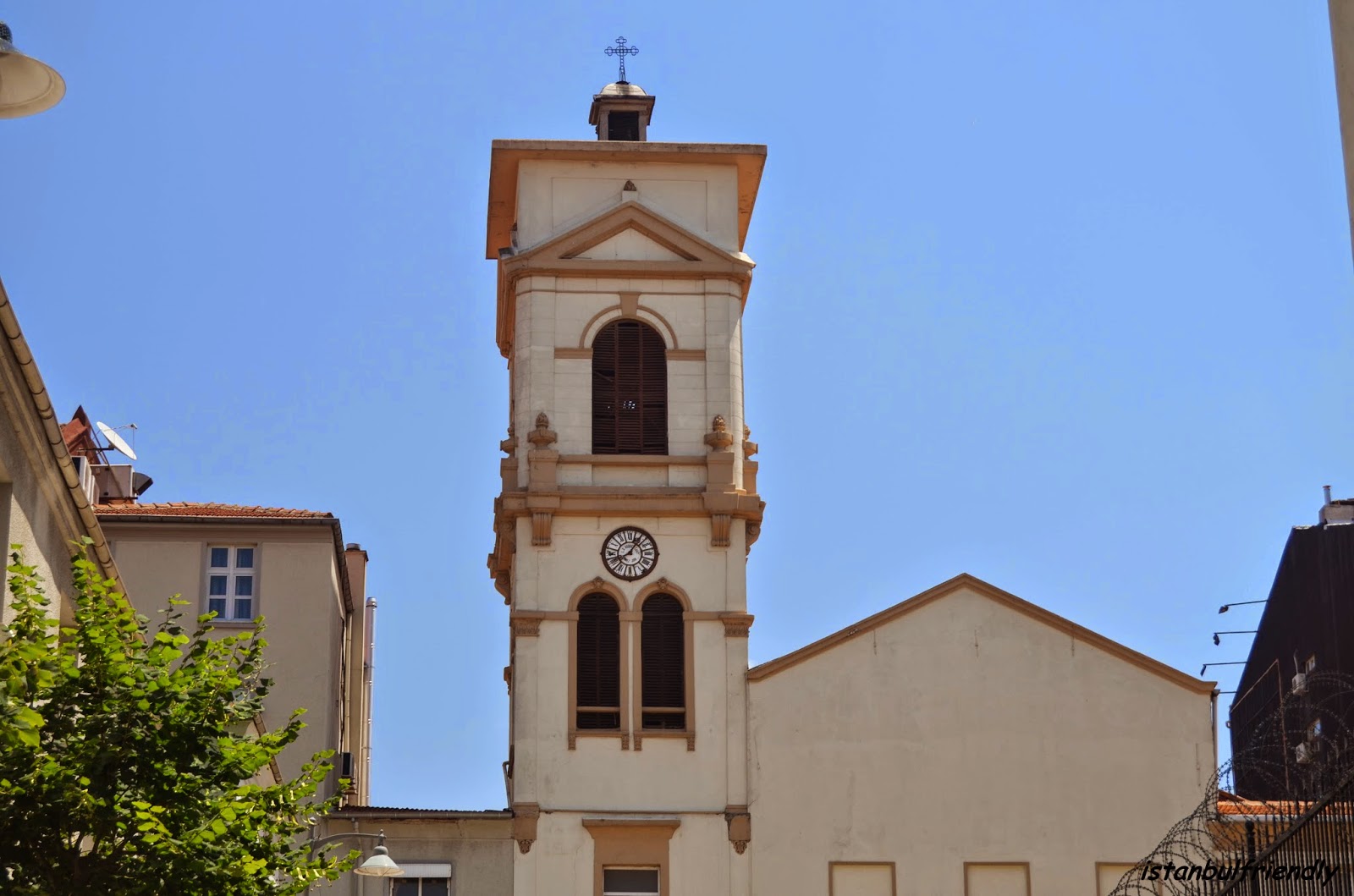
The belfry of St. Esprit Cathedral
Harbiye is also famous for its events:

Muhsin Ertugrul Theatre one of the biggest theatres in Istanbul, where you can watch the plays of Istanbul Municipality Theatre. Unfortunately, the plays are in Turkish.

Cemil Topuzlu Open Air Theatre houses some open air plays and concerts at summertime. Games are again in Turkish, but you can listen to the concerts of local and global musicians.

Lutfi Kirdar Convention and Exhibition Center was Istanbul Sports and Exhibition Center in 1948-1988, then it was named after Lutfi Kirdar, who was a doctor, statesman, soldier, governor of Manisa and Istanbul, deputy and minister of health. The building went into some restorations and took its recent shape.

How to get to Harbiye?


Harbiye is ten minute walk away from Taksim and Nisantasi, so it is a convenient option. You can use the metro, but then you should either walk from Pangalti or Taksim station (for no more than ten minutes). You can also get on a bus that works between Mecidiyekoy-Taksim line. TRT Istanbul Radio stop is exactly in front of Notre Dame de Sion. There are also shared taxies from Harbiye to Besiktas.

Where to stay in Harbiye?


There are many hotels and suits to stay in Harbiye. The ones on the main street will be more expensive. Try the smaller streets. Harbiye is generally a nice neighbourhood and the number of suits are increasing day by day.

If you have the budget, you can stay at Hilton Istanbul Bosphorus Hotel. I have never stayed at the hotel, so I can't tell anything about its services. The reason for me to put a footnote for this hotel is that it is the first five star hotel of Istanbul. It was opened in 1955. Another interesting thing is that Conrad Hilton  was the second husband of Zsa Zsa Gabor, who convinced Conrad to open a Hilton hotel in Istanbul. Zsa Zsa Gabor was a Hungarian actress and socialite, whose first husband was Burhan Asaf Belge. (Burhan Asaf Belge was a Turkish intellectual, his son Murat Belge is also a famous intelectual who has a detailed Istanbul guide, and his deceased nephew Yakup Kadri Karaosmanoglu is a famous novelist. What a family!)

So much for the gossip and Harbiye!

Tuesday, 27 January 2015

Elmadag: A Cosy Neigbourhood Near Taksim

Elmadag means "apple mountain" in Turkish. The confines aren't precise, but it is rougly between Harbiye, Taksim and Dolapdere.

Elmadag is very close to Taksim, so it is always popular among tourists, especially among Erasmus students and backpackers. There are many studio apartments, suites and rooms.

Elmadag Street is the next parallel to the Babil Street. There are many beautiful houses in between. Like Nisantasi, Harbiye and Taksim, the buildings are looks more Western. Surp Agop Apartment is one of the best examples you'll see around.

Surp Agop Hastanesi is an Armenian public hospital. I haven't been there yet, but people speak highly of it. So, if you need a hospital (I hope this won't happen), you can try it. However, it is a private hospital. The only public hospital is Sisli Etfal (because Taksim Acil is demolished in order to open space for a mall, and was carried to Gaziosmanpaşa, which has nothing to do with Taksim).


Where is Elmadag?


Elmada is between Harbiye and Taksim. There is directly a bus stop named Elmadag. I think you don't need to get on anything, when you are coming from Taksim. It is just a ten minute walk.

If you're coming from the other directing follow the bus stops: Harbiye, TRT Istanbul Radyosu and there you are, Elmadag.

There is no direct metro station. So, you'll have to walk either from Taksim or from Pangalti/Osmanbey.

Sunday, 25 January 2015

St. Esprit Cathedral: Papa Was There

St. Esprit Cathedral resides in Harbiye, on Cumhuriyet Street and next to Babil Street. It had very busy times a couple of months ago, because it hosted Pope Francis.

Today it is surrounded by Notre Dame de Sion High School. The entrance is from Cumhuriyet Street side. It has a lovely yard and a Papa XV. Benedictus statue on it. If you walk the rear street, the Papa Roncalli Street, you can see the bell tower. (The Vatican Consulate is also on the Papa Roncalli Street.)


The construction started in 1845 and the cathedral was open to worship in 1846. The architect is Gaspard Fossati. The cathedral was damaged by an earthquake in 1865. There is an underground grave, which was active until 1927. The grave of Giuseppe Donizetti, who founded Mizika-i Humayun (a military band), is there.


How to go to St. Esprit Cathedral?


It is very easy to visit St. Esprit. It resides in a beautiful district with convenient transportation. There is the bus stop, TRT Istanbul Radyosu, just in front of the high school. If you come from Taksim, you'll have to cross the road. If you come from Mecidiyekoy, you'll be there. You can also walk to and from Taksim, Nisantası, Tesvikiye, Macka and even Besiktas.

If possible, don't miss the Sunday service!


Friday, 23 January 2015

Tunel: The World's Second Oldest Tunnel at Taksim

Tunel means tunnel in Turkish, but it has come to define especially this particular one. It is actually a funicular line between Taksim and Karakoy. The journey takes 1,5 minutes, but add a couple of minutes for the passengers to get in and get off.


It is the second oldest (1875) underground line after the London Underground (1863). It was built in Moresque style. I like the colours and the patterns. In 1910 the electrical system became operational. There was originally two parallel lines. Today it has only one line with a short double section. When the two trains come side by side, you can see other passengers.

If you have the lungs, I'll recommend you walk the Yuksek Kaldirim Street, which inspired the famous poet Orhan Veli Kanik. His poem was sung by Levent Yuksel, if you like to listen modern Turkish pop.

Where is Tunel?


Tunel is at the Pera part of Taksim, on the other end of the Istiklal Street other than the Taksim Square. You can get on it either from Karakoy or from Taksim. There are three options for you to reach there: on foot, by tram and by the underground passage of the metro to Sishane.


Tuesday, 20 January 2015

From Genoese to Turkey: Galata Tower

Galata Tower is one of the oldest and one of the most fascinating artefacts in Istanbul. You should pay an entrance fee which in my opinion is a little bit more expensive than equivalent places (at least in Europe), but the view is worth it. Galata Tower gives you the chance to see a panoromic view of Istanbul. There is partly an elevator and partly stairs. It has a Romanesque style.

There is also a fun fact about the tower: When you climb it for the first time, be careful who you are climbing with, because s/he may be your future spouse. Believe it or not...

The view from a street of Galata.


History


There was an older tower that was closer to the sea, but the one standing today is relatively newer than that. The older tower was built by the Byzantines, and was destroyed by Latin crusaders in 1204. This Galata Tower was built by the Genoese at a nearby place. It was the biggest building of its time. But it didn't stay as it is. Actually it was looked after well, but it was probably unlucky. It was burned, rebuilt. The conical roof flew away with a storm, rebuilt.

Most of its history is interesting, but the most interesting moment is probably the moment Hezarfen Ahmet Celebi flew with his artificial wings from one continent to another (Galata to Uskudar) in circa 1630-1632. (His brother is Lagari Hasan Celebi, who is also an interesting historical figure.)

Where is Galata Tower?


It is very easy to go to the Galata Tower. You can use the Tunel from Karakoy and walk a couple of minutes. You can come from Taksim Squre on foot (recommended), by nostalgic tram (meh, just take photos of it), and the metro (the walk from underground to Sishane, preferable if the weather is bad). Walk straight from the Tunnel and keep looking for the first square. There stands the tower.

There used to be the youth sitting and chatting at the bottom of it, but the municipality didn't like the liveliness and instead, sold the area to a private tea house. However, you can see and hear "the rebels" sing and chat against all odds.

Thursday, 18 December 2014

Best 3D Cinemas in Istanbul

3D movies began with Avatar and it became an exciting branch of cinema. This week the last part of legendary Hobbit trilogy, Hobbit: The Battle of the Five Armies, has come out. All the fans are so excited. In case you are in Istanbul, you are lucky. There are many movie houses in Istanbul.


3D movie houses have different formats, such as IMAX and XPAND. IMAX is available only at Istinye Park and Marmara Park. Here is the list of them:

European Coast:


  • Beyoglu Atlas
  • Beyoglu Cinemaximum (Fitas)
  • Nisantasi CityLife (City's AVM)
  • Osmanbey Gazi
  • Mecidiyekoy Maximum (Cevahir)
  • Sisli Cinemaximum (Trump Towers)
  • Mecidiyekoy Profilo AVM
  • Zincirlikuyu Cinemaximum Zorlu Center
  • Levent Cinemaximum (Kanyon)
  • Levent Saphire Cinema Pink
  • Levent Ozdilek Cinetime
  • Etiler Akmerkez Cinema Pink
  • Istinye Cinemaximum (Istinye Park) IMAX
  • Deniz Private Cinecity Etiler
  • Fatih Cinemaximum (Historia)
  • Bakirkoy Cinemaximum (Marmara Forum)
  • Bakirkoy Cinemaximum (Capacity)
  • Bakirkoy Carousel Cinema Pink
  • Atakoy Cinemaximum (Atakoy Plus)
  • Florya Cinemaximum Aqua
  • Florya Cinefly Flyinn
  • Bayrampasa Cinemaximum (Forum Istanbul)
  • Eyup Cinemaximum (Vialand)
  • Gungoren Cinemaximum (Kale)
  • Bagcilar Site
  • Bagcilar 212 AVM Cinemarine
  • Esenler Espri Site
  • Bahcelievler Metroport Cine Vip
  • Maslak TIM
  • Yesilkoy Airport Cinemas
  • Deniz Private Cinecity Trio Atasehir
  • Yenibosna Starcity Site
  • Atasehir Novada Avsar
  • Sefakoy Sinemay Armoni Park
  • Esenyurt Cinemaximum Akbati
  • Beylikduzu Cinemaximum Marmara Park IMAX


Anatolian (Asian) Coast:


  • Altunizade Capitol Spectrum
  • Kadikoy Cinemaximum (Nautilus)
  • Kadikoy Rexx
  • Acibadem Cinemaximum (Akasya)
  • Göztepe Avsar Optimum
  • Caddebostan Cinemaximum (Budak)
  • Kozyatagi Avsar Kozzy
  • Umraniye Cinemaximum (Meydan)

Thursday, 11 December 2014

Talimhane Hotels: The Address to Superfine Holidays

Talimhane is actually a neighbourhood of Beyoglu. It is very close to Taksim Square and Gezi Park. Talimhane was once an exercise place for the army. Today it serves an entirely different purpose. It hosts many superfine hotels. You can also find fine restaurants around.

The list of hotels at the entrance near Gezi Park.

There are many hotels at Talimhane. Not all of them may be suitable for backpackers and students, but you can check them out for they are so central. There are boutique hotels, 4 star hotels, 5 star hotels and luxurious hotels. When you walk straight from this entrance to the end of the road, you'll reach Tarlabasi. Some Tarlabasi hotels are also counted as Talimhane hotels, because Talimhane doesn't have strict borders and it is okay that way.

Only pedestrians!

Talimhane is closed to traffic. So it is fun to walk around. You can go there by any means that takes you to Taksim Square. It is only one or two minutes walk from the square. By the way, you see the "P" of the Point Hotel at the right of the picture. And the right of it, there are Havatas buses that takes you to either Ataturk International Airport or Sabiha Gokcen Airport (with a fair price).

Monday, 1 December 2014

Gezi Park: The Rebellious Park of Istanbul

Gezi Park would probably be just another park in a city, if it hadn't hosted the greatest "social" demonstration in the history of Turkey. "It all started with a tree", you would hear. But when the police used disproportionate force against peaceful protesters who wanted to protect Gezi Park from becoming barracks, things went crazy. For a couple of months, flying gas canisters were a usual scene from Taksim to Galata and to Harbiye, and also at Kadikoy. It is worth to remind that despite fierce political sayings, the park is still there, safe and sound, and I'm glad to tell you about it.


The History of Gezi Park


When you see Gezi Park, you may find it small in comparision with other parks at other big cities in the world. But the park's newly assigned historical significance makes it larger than life. However, it doesn't mean the only historical memory of the park.

Let's start with earlier records. The area including Gezi Park, Divan Hotel (the hotel next to the park that let the protestors in when the violence was at its peak), Hyatt Regency Hotel, and some parts of Istanbul Radyoevi (broadcasting house) and Harbiye Orduevi (military museum and cultural center of command) was Pancaldi Armenian Graveyard, or Surp Agop Graveyard. (Surp Agop Apartment still exists, but the hospital was demolished last year and the apartment serves as a polyclinic. The graveyard being at the opposite of the hospital was plausible indeed.) The land was given to Armenians in about 1560, when there was a plague. From then on, it was used as a graveyard.

At that time, Pancaldi, Harbiye and Elmadag was considered as being outside the city. The "core" Istanbul was approximately the part where today Eminonu, Karakoy, Galata and Pera (the far end of Istiklal Street). So, the dead was allowed to be buried only outside Istanbul. In 1853, it was confined with walls. In 1856, the name plate was put. In 1865, with the cholera epidemic, burial processes were banned due to its "proximity" to the city. (Things change.)

In 1872, the municipality comandeer the area but Sultan Abdulaziz enacted an addict announcing it belonged to Armenians. In 1926, the burial processes were entirely banned and it was decided that the graveyard was to be transferred to some other place. In 1931, Istanbul Municipality that the land should be assigned to it. The case was closed in 1934 and the large part was given to the municipality. In 1938, it was announced that the graveyard would be demolished and fifteen days were given to transfer the graves, if interested.

The yellow building is Divan Hotel.

In 1939, the graveyard was totally demolished, along with Khor Virap Church. The gravestones were used for the stairs of Yeni Cami (New Mosque) in Eminonu, and for the stairs of Gezi Park, which was being built at that time.

Let's move to another historical part. In 1806, Halil Pasa Topcu Kislasi (Halil Pasha Artillery Barracks) was built at today's Gezi Park. At 31 March Incident, it became the headquarters of rebels who were -in brief- in favour of sharia, and against more liberal policies of Ittihak Terakki Cemiyeti, Party of Union and Progress. (Maybe, things never change.) The rebellion was suppressed by the army.

As Beyoglu (the district which also comprises Taksim, in case you're confused) developed towards Sisli, the barracks lost its function and it became a stadium in 1922. Henry Proust, the controversial city planner, offered authorities a plan that involved Nisantasi, Harbiye, Dolmabahce and Gezi Park. In 1940, after the stadium was demolished, Gezi Park became the first park of the Republic (of which steps were carried from the demolished graveyard).

Well, it isn't a coincidence for Gezi Park to host such heated protests.

Those were the days, my friend.


Where is Gezi Park?


Gezi Park is stuated close to Taksim Square, which is unfortunately a big gray gap nowadays. If you put Taksim on your front, the left road will take you to Macka and ultimately to Besiktas or Kabatas. The right road will take you to Elmadag and Harbiye with a ten minute walk, or Nisantasi with a fifteen minute walk. If you like, you can take the metro from Taksim and go to Osmanbey (adjecent to Nisantasi), Sisli, Mecidiyekoy and further stations.

The bus stations were carried under ground to save Taksim from traffic (and probably with frustration due to the cancellation of "new Taksim" plan). It's a little tricky right now. If you want to get on the buses which passes from Besiktas (and to the coastline, that is Ortakoy, Arnavutkoy, Tarabya, Sariyer, etc., or the Anatolian coast, that is Kadikoy, Bostanci, etc.), you should walk left from the Gezi Park for a while to reach the bus station next to Ataturk Library. If you like to get on a bus which passes from Sishane (to Karakoy, Eminonu, Aksaray, Beyazit, Laleli, Bayrampasa Main Bus Station, Ataturk International Airport, etc.), you should walk down to the station which has an entrance facing Gezi Park. It seems complicated at the first time. It really is. Once I gave up to meet my friend at Kadikoy.

As I mentioned above, Gezi Park is relatively small. You can walk around in ten minutes at best. However, if you sit on a bench or cobblestones, it will take hours to contemplate on its history.


Copyright © 2015 Istanbul Friendly